The most convenient app on your phone might actually be the biggest obstacle to a stress-free airport transfer. When you’re weighing up Uber verses Taxis for a high-stakes journey in 2026, the cheapest option on your screen often hides a wealth of unpredictability. We’ve all experienced that sudden spike of anxiety when a driver cancels minutes before a departure, or when a standard fare triples because of a local event you didn’t know was happening. You deserve a transit solution that respects your schedule and your budget without the threat of last-minute surcharges.
You likely value the peace of mind that comes with a guaranteed pickup time and a professional driver who understands the nuances of UK transit logistics. This article will help you discover the critical differences between ride-hailing apps and professional taxi services to ensure your next journey is cost-effective, safe, and stress-free. We’ll examine the impact of the 2026 VAT changes on fares, the new national licensing standards, and how to choose a service that provides ample space for your luggage and a truly professional experience from door to terminal.
Key Takeaways
- Learn how 2026 licensing regulations ensure professional drivers maintain higher standards of accountability than typical app-based services.
- Understand the cost benefits of Uber verses Taxis, including how fixed fares shield you from the 20% VAT now applied to London app rides and volatile surge pricing.
- Discover why the “certainty premium” of a pre-booked airport transfer is essential for avoiding last-minute cancellations during high-stakes travel.
- Compare the vehicle maintenance protocols of professional fleets against the variable quality often found in the gig economy.
- Identify the specific scenarios where a professional long-distance service provides better value and less stress than a spontaneous app booking.
Understanding the Fundamental Differences Between Uber and Taxis
Choosing between Uber verses Taxis often feels like a simple choice of convenience, but the real distinction lies in the underlying business structure. While ride-hailing apps act as digital intermediaries between independent contractors and passengers, traditional private hire firms operate as licensed entities with direct accountability. In Brighton and East Sussex, this means every journey is overseen by an operator responsible for driver conduct and vehicle safety. You aren’t just booking a car; you’re engaging a service that’s legally obliged to manage your transit logistics from start to finish.
To better understand the historical context of this competition and how it has shaped modern travel, watch this helpful video:
Local authorities like Brighton & Hove City Council enforce strict standards that differ significantly from the gig-economy model. The role of the “operator” is a legal requirement for private hire services, serving as a central point of contact for bookings and passenger safety. This structure addresses many of the global controversies surrounding ride-sharing by ensuring a clear chain of command. With the English Devolution and Community Empowerment Bill now law as of April 2026, national minimum standards are raising the bar for licensing, yet the local operator remains your best guarantee of service quality.
Private Hire vs Hackney Carriage: What You Need to Know
It’s vital to understand the legal divide between vehicle types. Hackney Carriages can be hailed on the street or found at designated ranks, often using a meter to calculate fares. Private hire vehicles, including professional airport taxis, must be pre-booked through a licensed operator. A private hire driver cannot legally pick up a passenger who hasn’t booked in advance. This pre-booking requirement is actually a safety benefit for you. It creates a digital and physical paper trail, ensuring the driver, vehicle, and passenger are all logged within a regulated system before the wheels even turn.
The Evolution of the Taxi Industry in 2026
By 2026, the technological gap between apps and local firms has largely disappeared. Professional services now utilise sophisticated dispatch systems and GPS tracking that rival any global platform. However, they’ve maintained the personal touch that automated algorithms lack. In the Brighton area, there’s a visible shift towards electric and hybrid fleets to meet local environmental standards. These professional standards remain the core differentiator for high-stakes travel. For long-distance travel or a seaport transfer, the certainty of a local expert who knows the quickest routes through the South Downs is far more valuable than a random app assignment.
Comparing Pricing Models: Surge Pricing versus Fixed Fares
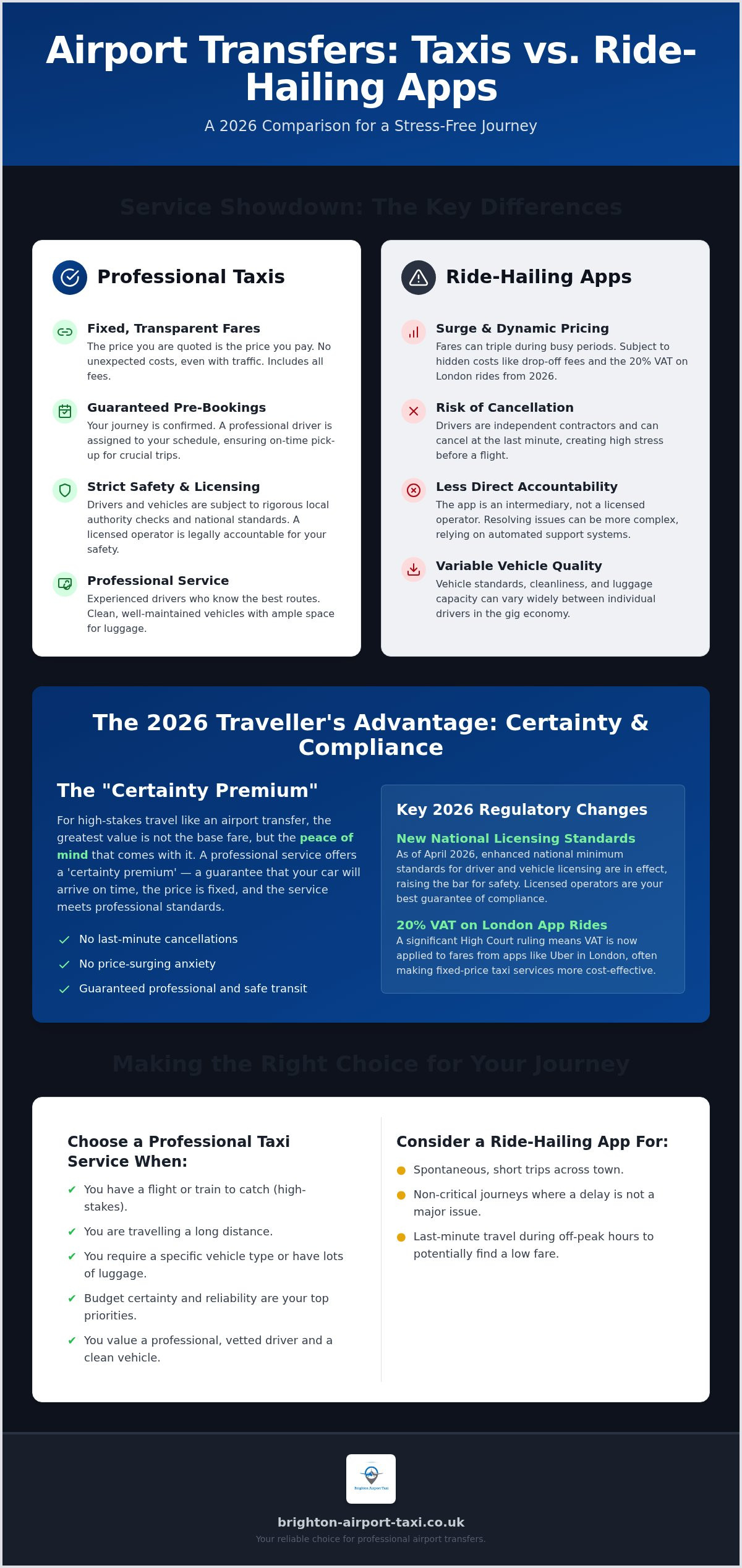
Financial transparency is the cornerstone of a stress-free journey. When you evaluate Uber verses Taxis, the primary point of friction is often the final bill. Uber utilises a dynamic pricing algorithm that responds to real-time demand, meaning the price you see when you first check the app can fluctuate wildly within minutes. In contrast, professional private hire firms provide a fixed-price model. This ensures the quote you receive during the booking process is the exact amount you pay, regardless of traffic congestion or route diversions. According to official 2026 taxi and PHV statistics, the number of licensed private hire vehicles has increased by 13% since 2024, yet the demand for transparent, non-algorithmic pricing remains a top priority for regular travellers.
The “cheapest” option on your screen often carries hidden costs that only appear at checkout. Whilst an app might show a lower base rate, it frequently excludes essential extras like airport drop-off fees or waiting time charges. Professional services typically bundle these costs into a single, transparent figure. This is particularly relevant in 2026, as many UK airports have restructured their terminal access fees. By choosing a fixed-price service, you eliminate the risk of “fare creep” where a thirty-minute journey becomes significantly more expensive due to unexpected motorway delays.
The Reality of Surge Pricing in Brighton
Brighton’s unique calendar of events creates a volatile market for app-based transport. During Brighton Pride, major rail strikes, or even a sudden downpour on the seafront, Uber’s surge multiplier can double or triple the standard fare. These spikes aren’t just inconvenient; they’re often unpredictable. A fixed fare acts as a financial shield, protecting you from these opportunistic price increases. Knowing your exact travel cost weeks in advance allows for better holiday budgeting and removes the anxiety of watching a meter rise whilst sitting in traffic on the A27.
Airport Transfer Fares: A Direct Comparison
For high-stakes travel, an estimated fare is a gamble you don’t need to take. Booking a brighton airport taxi provides a level of cost certainty that ride-hailing apps cannot match. This is especially true when you consider “Meet and Greet” services. Whilst an Uber driver might expect you to navigate a busy terminal to find them in a crowded short-stay car park, a professional transfer includes a personalised reception. This service often covers the initial parking fees, ensuring you aren’t hit with undisclosed surcharges the moment you step into the vehicle.
The concept of “dead mileage” also impacts long-distance pricing. Because professional firms specialise in transit to major hubs, they often optimise their schedules to reduce empty runs, passing those efficiencies on to you. If you value a journey where the price is as reliable as the pickup time, you should request a fixed-price quote for your next airport run.
Reliability and the ‘Airport Transfer Test’
When your flight departs at dawn, the “on-demand” model is a significant gamble. The debate of Uber verses Taxis is most intense when reliability is non-negotiable. While app-based services rely entirely on driver proximity at that exact moment, professional firms organise their schedules days in advance. This proactive approach eliminates the uncertainty that plagues the gig economy. Even though there are 417,300 licensed taxi and PHV drivers in England as of April 2026, sheer volume doesn’t guarantee a pickup in a quiet residential street at 3 AM. Professional firms use sophisticated dispatch software to ensure a vehicle is assigned to your booking well before you need to leave.
Cancellation culture is a documented reality for ride-hailing users. Drivers may accept a job only to cancel minutes later if a more profitable short-hop appears nearby. In contrast, a professional operator manages a dedicated fleet with a commitment to every booking. They utilise real-time flight tracking to adjust for delays, ensuring your driver is waiting at the terminal regardless of when you land. This level of oversight provides a “certainty premium” that automated apps simply cannot replicate.
The Risk of Last-Minute Cancellations
Why would a driver decline a trip from Brighton to London? Often, it’s about the return journey. App drivers frequently fear “dead mileage” where they can’t find a fare back to their home territory, making long-distance trips less attractive. A confirmed booking with a local firm provides 24/7 dispatch support, meaning you have a human being ensuring your car arrives. Local expertise is also vital. Drivers familiar with East Sussex roadworks on the A23 or A27 can pivot routes immediately; it’s a level of intuition that generic GPS apps often lack during peak travel times.
Specialised Service for Seaports and Long Distances
Seaport transfers require a higher level of coordination than a standard city hop. When you’re heading to Southampton or Dover for a cruise, timing is critical. Professional drivers for seaport transfers are accustomed to handling the heavy luggage requirements of cruise passengers. Large groups often find that standard app vehicles don’t have the boot capacity for multiple large suitcases. Pre-booking allows you to specify a vehicle size that comfortably fits all passengers and their belongings, ensuring the journey begins with calm rather than a struggle to fit bags into a small hatchback.
Safety, Licensing, and Professional Standards in 2026
In 2026, the regulatory environment for passenger transport has reached a new level of stringency. When comparing Uber verses Taxis, the most significant difference lies in the depth of the vetting process and the chain of accountability. Local authority-licensed drivers must undergo enhanced DBS checks and, as of April 2026, 76% of licensing authorities in England mandate disability awareness training. Professional firms often go further, maintaining strict internal policies that exceed these national minimum standards. This ensures that your driver isn’t just a vehicle operator, but a vetted professional trained to handle complex travel requirements with a high degree of care.
Company fleet policies offer a level of oversight that the gig economy often lacks. Whilst ride-hailing apps require vehicles to meet certain age and model criteria, the daily maintenance and cleanliness are the sole responsibility of the individual owner-driver. This level of quality is a hallmark of elite services worldwide; for example, ABS Transportations showcases how professional fleet management ensures a premium and safe environment for every passenger. Professional private hire firms operate under a similar model, where the operator has a direct stake in the fleet’s condition. This is particularly vital for long-distance travel, where vehicle reliability and comprehensive insurance coverage are essential for passenger protection. You shouldn’t have to worry if your car is mechanically sound or if the insurance specifically covers high-mileage transit across county lines.
Driver Accountability and Local Expertise
Vehicle Suitability for Different Journeys
Booking through an app often feels like a gamble. You might request a standard car and receive a vehicle that is poorly suited for an airport run with multiple bags. Professional firms allow you to select the exact vehicle class you need, ensuring child seats and accessibility requirements are met every time. There is also a “cleanliness guarantee” inherent in a professional service. Because these drivers represent a local brand, the interior standards are consistently high, avoiding the “luck of the draw” nature of part-time ride-hailing vehicles. If you require a vehicle that meets the highest safety and cleanliness standards, book your professional airport transfer with a local expert today.
Making the Choice: When to App and When to Pre-book
Deciding between Uber verses Taxis often comes down to the specific requirements of your itinerary. For a spontaneous, short-distance trip across Brighton city centre, the immediacy of a ride-hailing app is undeniably convenient. If you’re simply heading from the North Laine to a restaurant in Hove, the “on-demand” model works well. However, as the stakes of the journey increase, the value of a professional pre-booked service becomes the deciding factor. For high-stakes travel, such as a Brighton to Heathrow taxi run, the risks associated with driver availability and last-minute cancellations are simply too high to ignore.
Group travel and curated day tours in East Sussex represent another scenario where professional firms excel. Unlike ride-hailing platforms that offer little control over vehicle type, professional operators can provide specific solutions like minibuses or estate cars. This addresses a common gap in the market regarding specialised needs. If you require child seats for a family trip to the South Downs or need a vehicle with significant boot space for cruise luggage, a pre-booked service ensures these requirements are met before the driver arrives at your door. This level of preparation is essential for maintaining a stress-free environment during complex travel days.
When Pre-booking is the Only Logical Option
Punctuality is the primary reason business travellers and holidaymakers prioritise Brighton to Gatwick taxi bookings for early departures. When you have a 6 AM flight, you cannot rely on the hope that a driver is active in your neighbourhood. Similarly, seaport transfers to Southampton or Dover require precise coordination to align with strict boarding windows. A professional account service offers the consistency that corporate travellers demand, providing a reliable paper trail for expenses and a guaranteed vehicle regardless of peak-hour demand or local traffic conditions.
The Verdict for 2026 Travellers
The ultimate travel strategy for 2026 involves balancing the convenience of technology with the reliability of human expertise. Whilst apps have their place for casual urban transit, they lack the logistical depth required for airport transfers and long-distance travel. For residents in Brighton, Saltdean, and the surrounding areas, the recommendation is clear: use technology for the spontaneous, but trust a professional operator for the critical. By combining both services, you can enjoy the flexibility of modern apps whilst retaining the peace of mind that only a dedicated, local private hire firm can provide for your most important journeys.
Securing a Stress-Free Journey for Your 2026 Travels
Navigating the UK’s evolving transport landscape requires a balance between modern convenience and unwavering reliability. The debate of Uber verses Taxis often centres on app accessibility, yet the real value for any traveller lies in the certainty of a fixed price and a guaranteed pickup. You’ve seen how professional standards and local expertise create a superior environment for high-stakes journeys like airport transfers or seaport transfers. Choosing a service with a dedicated operator ensures you aren’t left at the mercy of an algorithm during peak demand or early morning departures.
We specialise in airport and long-distance logistics, providing the precision that spontaneous apps often lack. Every booking includes a professional “Meet and Greet” service as standard, ensuring a seamless transition from the terminal. You’ll never face hidden surge pricing with us, regardless of local events or traffic conditions. We are dedicated to providing a calm, professional alternative to the unpredictability of the gig economy.
Book your reliable, fixed-price Brighton airport transfer today and enjoy the confidence that comes with a service rooted in hospitality and local expertise. We look forward to making your next trip a success.
Frequently Asked Questions
Is Uber cheaper than a local taxi in Brighton for airport runs?
Uber may appear cheaper initially, but it often lacks the all-inclusive nature of a professional transfer. When you factor in the 20% VAT now applied to London-centric journeys and the potential for surge pricing, the gap narrows. Professional airport transfers provide a fixed price that covers terminal drop-off fees. This transparency ensures you don’t face unexpected costs at the end of your journey, making it a more predictable choice for budgeting.
Can I pre-book an Uber in Brighton with a guaranteed price?
Uber allows you to schedule a ride in advance, but this does not guarantee a fixed price or a specific driver. The fare remains an estimate that can fluctuate based on demand at the actual time of departure. In contrast, a professional private hire firm provides a binding quote. This means the price you are quoted weeks in advance is exactly what you pay, regardless of any traffic delays or sudden demand spikes.
What happens if my Uber driver cancels my airport transfer?
If a driver cancels, the app simply attempts to find another nearby driver, which is a high-risk scenario for time-sensitive travel. There is no human dispatcher to intervene or prioritise your booking. When you use a professional airport taxi service, the operator manages the fleet to ensure a vehicle is always available. This oversight provides a level of security that on-demand apps cannot match, particularly for early morning flights or late-night arrivals.
Are local taxi drivers more vetted than Uber drivers in the UK?
All licensed drivers in the UK must undergo enhanced DBS checks, but local authority standards for private hire firms are often more rigorous. As of April 2026, 76% of English licensing authorities require specific disability awareness training. Beyond this, local drivers often possess a deeper understanding of regional geography. This expertise allows them to navigate Saltdean and Brighton more efficiently than those relying solely on generic GPS algorithms found in most ride-hailing apps.
Do Brighton taxis charge extra for luggage or late-night pickups?
Hackney carriages at street ranks use metered tariffs that often increase during late-night hours or on public holidays. However, professional private hire firms specialising in long-distance travel typically offer a flat rate regardless of the time of day. This fixed-price model usually includes standard luggage capacity. It’s always advisable to confirm your passenger count and bag requirements during the booking process to ensure the vehicle provided is perfectly suited for your needs.
How do I ensure my taxi has a child seat for a long-distance trip?
To guarantee a child seat, you should book through a professional private hire operator and request the equipment in advance. Most ride-hailing apps do not offer a reliable way to ensure a vehicle arrives with the correct safety seat for your child’s age. Professional firms understand the logistical needs of families. They can organise a vehicle that meets all safety requirements, providing a much safer and more comfortable environment for long-distance travel.
Which is better for a group of 6 people: Uber or a local minibus taxi?
A local minibus taxi is almost always the better choice for groups of six. Whilst UberXL can technically seat six passengers, these vehicles often have very limited boot space when all seats are in use. This frequently results in groups needing to book two separate vehicles to accommodate their luggage. A professional firm can provide a dedicated minibus with a separate luggage compartment, ensuring everyone travels together comfortably in a single, cost-effective vehicle.
Are there hidden fees when booking a taxi from Brighton to Heathrow?
There are no hidden fees when you book through a reputable professional firm that provides a fixed-price quote. This transparent figure includes airport drop-off charges, which are a common surprise for those comparing Uber verses Taxis. A professional operator will also account for any ULEZ or congestion charges in the initial price. This honesty is a core part of the service, ensuring you can finalise your travel budget without worrying about undisclosed surcharges.