
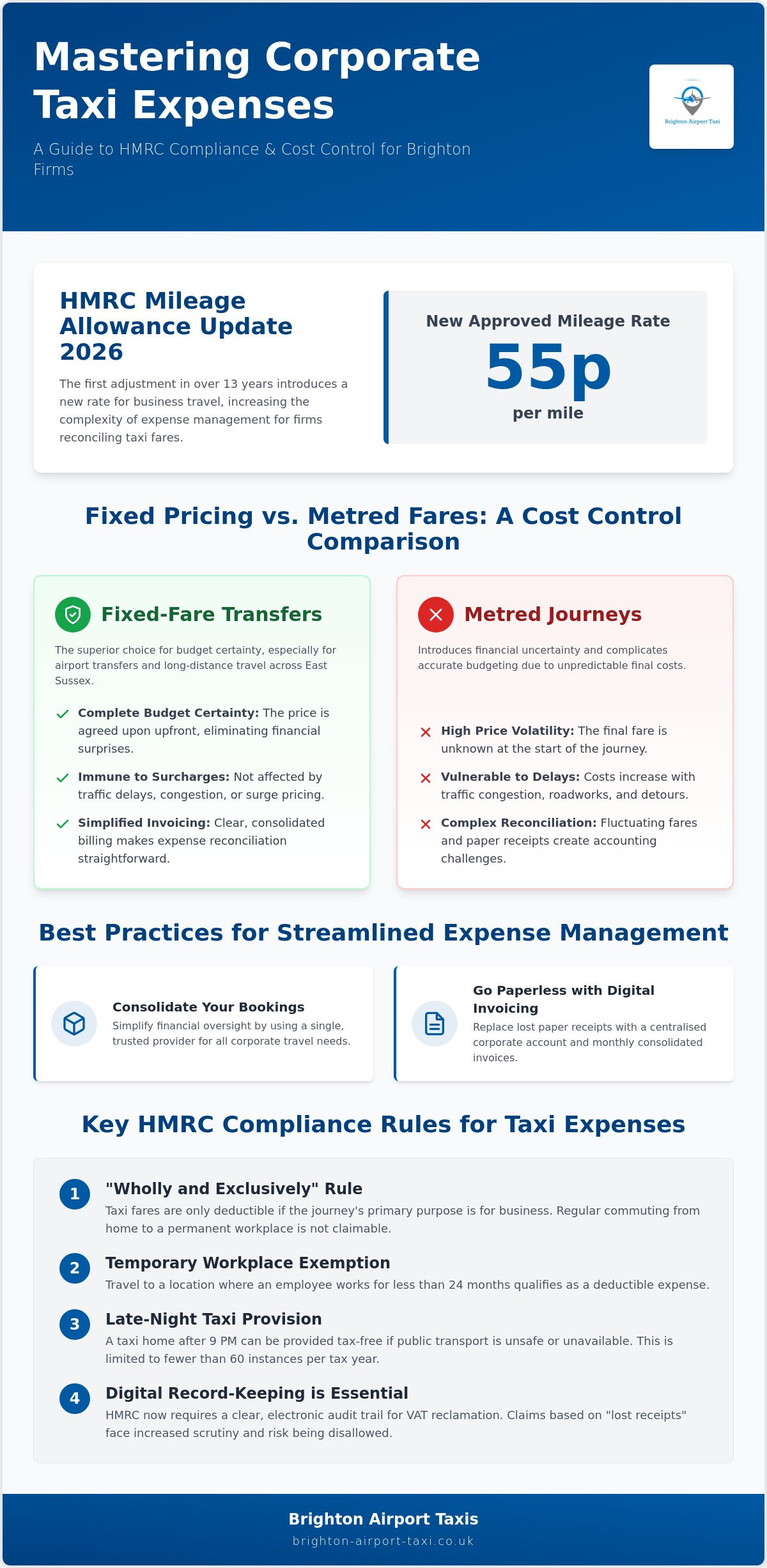
Did you know that the 10p increase in the HMRC mileage allowance for 2026 represents the first adjustment to these rates in over 13 years? For many Brighton firms, managing business travel expenses taxi costs has become a complex task of balancing these new 55p per mile rates against fluctuating metered fares. You likely feel the frustration of reconciling monthly travel statements only to find missing receipts and unpredictable surcharges for simple airport transfers.
It’s understandable that you want a system that works as hard as your team does. We’ll help you master the complexities of ground transportation costs whilst ensuring strict HMRC compliance and reliable employee punctuality. This guide examines the benefits of fixed pricing for airport transfers, explains the latest regulatory updates for the 2026/2027 tax year, and provides a clear framework for a streamlined, paperless expense process. You’ll discover how to replace the uncertainty of the meter with predictable, professional transit solutions that keep your accounts department and your passengers equally satisfied.
Key Takeaways
- Learn how to navigate the 2026 HMRC “wholly and exclusively” rule to ensure your ground transportation claims remain fully compliant.
- Discover how consolidating your bookings with a single provider simplifies managing business travel expenses taxi costs whilst improving financial oversight.
- Understand why fixed-fare airport transfers offer superior budget certainty compared to metred journeys affected by East Sussex traffic congestion.
- Move away from ad-hoc bookings and lost paper receipts by implementing a centralised corporate account with monthly consolidated invoicing.
- Leverage local logistics expertise to ensure employee punctuality for critical long distance travel and airport transfers.
Understanding Business Travel Expenses and HMRC Compliance
Business travel expenses are the costs your staff incur whilst performing their professional duties. HMRC dictates that for any taxi fare to be deductible, it must be incurred “wholly and exclusively” for business purposes. This means the journey’s primary objective cannot be personal. Effective Corporate travel management relies on understanding these definitions to protect your company from unnecessary tax liabilities and ensuring every claim stands up to scrutiny.
To better understand how these costs are calculated and categorised, watch this helpful video:
Effectively managing business travel expenses taxi costs starts with identifying which journeys are actually claimable. Deductible expenses typically include airport transfers for international meetings, travel to a client’s site, or transit between different company branches. For the 2026 tax year, the focus on digital evidence has intensified; many businesses are now consulting Chartered Certified Accountants London to navigate these changes and protect their tax relief status. HMRC expects a clear, electronic trail for VAT reclamation, making it essential to move away from the “cash and carry” approach of previous decades. If your records don’t clearly show the business intent of a trip, you risk losing out on significant tax relief.
What Qualifies as a Legitimate Taxi Expense?
Legitimate taxi expenses extend beyond simple office-to-office trips. Whilst ordinary commuting from home to a permanent office is never deductible, travel to a temporary workplace is fully claimable. HMRC defines a temporary workplace as a location where an employee works for less than 24 months. There is also a specific exemption for late-night taxis. If an employee is required to work past 9 PM and public transport is either unavailable or unsafe, the company can provide a taxi home tax-free. This applies as long as such instances occur fewer than 60 times in a tax year. Client entertainment is more complex; whilst the taxi fare to a dinner might be deductible as a business expense, the VAT treatment differs from standard travel.
The Problem with Paper Receipts
Relying on physical scraps of paper is a significant financial risk. Manual receipt management frequently leads to accounting errors and, more importantly, lost VAT recovery. Professional Brighton taxi companies have largely moved toward digital invoicing to help firms capture every eligible pound amongst their travel spend. HMRC audits now treat “lost receipt” claims with increased scrutiny. Without a valid digital record, these claims are often a red flag for inspectors. A digital-first approach ensures your records are robust, transparent, and ready for inspection at any time, providing peace of mind for both the finance team and the employee.
Best Practices for Controlling Ground Transportation Costs
Effective control isn’t just about cutting costs; it’s about creating a predictable environment for your finance team. When managing business travel expenses taxi usage often represents a significant portion of “invisible” spend that is difficult to track accurately. You can gain immediate control by moving away from on-demand apps that rely on volatile surge pricing. Instead, consolidate your travel through a single, trusted provider. This allows you to leverage your total travel volume and secure priority service during peak periods without the risk of unexpected price hikes.
Pre-booking is the most effective way to eliminate last-minute premiums. Whilst metred cabs are useful for spontaneous short hops, they introduce financial risk for longer journeys across East Sussex. A fixed-fare model ensures that traffic delays on the A23 or congestion near Gatwick don’t inflate your final bill. This level of transparency is vital for accurate budgeting and aligns with broad international standards for deductible travel expenses, where clear, itemised documentation of costs is paramount for compliance.
Designing a Robust Travel Policy
A well-defined policy sets clear expectations and removes the guesswork for employees. You should establish spending limits based on seniority and define “preferred routes” for high-frequency trips like Brighton to London. For local requirements, your team should follow a specific protocol for using a taxi brighton hove service to ensure they aren’t overpaying for short-distance transfers. Clear guidelines prevent confusion and ensure every journey is authorised before it’s taken.
Monitoring Travel Behaviour and Patterns
Regular reporting helps you identify which transit hubs your team uses most frequently. You might find that pre-booked taxi transfers are actually more cost-effective than paying for long-stay airport parking, especially when you factor in fuel costs and the value of an employee’s time. Analysing these patterns allows the finance department to spot “expense leakage”, such as employees choosing premium vehicle classes when a standard saloon is more appropriate for the journey.
By centralising your bookings, you ensure that every trip is tracked and accounted for from the moment of reservation. If you’re looking to simplify your next journey, you can organise your airport transfers through a professional account to experience this level of pricing certainty firsthand.
Fixed Pricing vs. Metred Fares: The Expense Manager’s Perspective
Expense managers face a daily battle with variable costs. Whilst metred fares are the standard for local Hackney Carriages, they introduce a level of volatility that makes managing business travel expenses taxi accounts significantly harder. A fixed-price model removes the gamble of the ticking meter, providing a transparent figure at the point of booking that doesn’t change regardless of the route taken. This transparency is the foundation of corporate trust, allowing finance teams to authorise spend with total confidence.
Traffic congestion in East Sussex often turns a standard journey into a costly delay. Whether it’s a bottleneck on the A23 or roadworks on the M23, a metred fare continues to rise even when the vehicle is stationary. By contrast, a professional private hire service absorbs these logistical risks. This approach aligns with the HMRC guidance on travel expenses, which requires clear evidence of costs for tax relief. Reconciling a single, fixed-price invoice is infinitely simpler than chasing multiple drivers for metred receipts that may or may not include waiting time surcharges.
Why Budget Predictability Matters for SMEs
Small and medium enterprises operate on tighter margins where cash flow management is critical. If your firm is looking for ways to spread the cost of HMRC bills to protect that liquidity, click here to learn more about tax funding from V4B Business Finance. Forecasting monthly travel spend with 100% accuracy becomes possible only when you move away from variable rates. Fixed pricing eliminates “fare shock” for employees arriving at major hubs like Gatwick or Heathrow, where on-the-day prices can be eye-watering. Such certainty allows business owners to allocate resources more effectively, knowing that their ground transportation budget won’t be blown by a single week of heavy traffic or rail disruptions.
The Hidden Costs of “Cheap” App-Based Taxis
App-based services often lure users with low baseline prices, but these are frequently subject to aggressive surge pricing during peak Brighton travel times. You might find your costs doubling during a rail strike or a sudden downpour. There is also the hidden cost of employee time; “nearest driver” algorithms are notoriously unreliable for time-sensitive departures. Choosing a dedicated brighton to gatwick taxi with a pre-agreed fixed fare is almost always more economical. It guarantees a driver is assigned specifically to your booking, avoiding the stress and potential cost of a missed flight due to a cancelled app request.
Streamlining Your Corporate Travel Policy
Moving from ad-hoc bookings to a centralised corporate account is the most effective way to gain visibility over your company’s transit spend. When employees book their own travel independently, you lose the ability to track patterns, negotiate rates, or enforce policy. Centralising your requirements through a professional account simplifies managing business travel expenses taxi costs by providing a single point of truth for every journey taken. This transition also ensures you meet your duty of care obligations. By using vetted, professional Brighton drivers instead of unverified app-based contractors, you guarantee a safe and reliable environment for your staff. Reliability is the cornerstone of business travel, and a dedicated provider ensures that your team arrives at their destination refreshed and on time.
Transitioning to Centralised Invoicing
Processing dozens of individual expense claims every month is a significant administrative burden for any finance department. Consolidated monthly invoicing replaces this chaos with a single, itemised statement that lists every trip, passenger, and cost centre. This improvement in record-keeping makes VAT recovery straightforward, as every journey is clearly documented with the necessary tax details required by HMRC. Most professional providers now offer digital statements that you can easily integrate into your existing accounting software like Xero or Sage. This level of oversight is a game-changer for managing business travel expenses taxi accounts, providing the financial transparency that modern business management demands whilst eliminating the risk of lost paper receipts.
Enhancing the Passenger Experience
Your choice of ground transportation reflects directly on your company’s reputation and professional standards. When visiting clients or international partners arrive at the airport, a personalised “meet and greet” protocol provides a level of hospitality that public transport or standard cabs cannot match. Professional drivers offer more than just a ride; they provide a calm, comfortable environment for long distance travel where executives can work or rest in private. This specialised service is equally valuable for managing seaport transfers or day tours for visiting guests, ensuring that every leg of their journey in the UK is handled with expert care. High-quality vehicles and knowledgeable local drivers ensure that your guests feel valued from the moment they land until they reach their final destination.
Establish a more efficient way to travel by opening a corporate account for your Brighton airport transfers today.
Why Brighton Businesses Choose Brighton Airport Taxis for Corporate Travel
Choosing a local specialist is about more than just proximity; it’s about partnering with a team that understands the specific logistical challenges of the South East. Brighton businesses require a service that bridges the gap between local reliability and global transit hubs. We offer a refined approach to managing business travel expenses taxi requirements, ensuring that every booking is handled with the precision your organisation expects. Our drivers are experts in the regional road networks, staying ahead of potential delays on the A23 or M23 to keep your schedule on track.
The reliability of a dedicated brighton to heathrow taxi transfer is a cornerstone of our service. This journey, covering approximately 63 miles, requires a steady hand and a clear understanding of timing. By choosing a specialist, you avoid the uncertainty of app-based drivers who may not be familiar with the nuances of Heathrow’s terminal layouts or the specific traffic patterns of the M25. Our commitment to transparent, fixed pricing means the quote you receive is the final amount you pay, with no undisclosed fees or “peak time” surcharges. This honesty is central to the way we build long-term corporate relationships.
Reliability Across the South East
Our service territory extends beyond the city centre to include Hove, Saltdean, and the wider East Sussex region. We understand that business doesn’t only happen during office hours. Whether you have a late-night arrival at a seaport or an early-morning departure for an international flight, our 24/7 availability ensures you are never stranded. We provide punctuality guarantees for all critical transfers, giving you the peace of mind to focus on your upcoming meeting rather than the logistics of the journey.
- Direct airport transfers to Gatwick, Heathrow, and Stansted.
- Specialised seaport transfers for international maritime travel.
- Reliable long distance travel for client meetings across the UK.
- Personalised day tours for visiting corporate guests.
Set Up Your Business Account Today
Registering for a corporate account is a straightforward process designed to integrate seamlessly with your existing workflows. We provide customised solutions for firms with regular long-distance travel requirements, allowing you to set preferred routes and vehicle types. This centralised approach eliminates the administrative burden of managing business travel expenses taxi claims, replacing them with a single, clear monthly statement. Our team is ready to help you transition to a more efficient, professional way of moving your people.
Contact Brighton Airport Taxis to simplify your business travel today and experience the difference that local expertise makes to your corporate logistics.
Optimise Your Corporate Ground Transportation Strategy
Success in the 2026 tax year requires a shift from reactive, ad-hoc bookings to a proactive, centralised strategy. By prioritising HMRC-compliant digital record-keeping and moving away from the volatility of metered fares, your finance team can achieve total budget predictability. The key to managing business travel expenses taxi costs lies in choosing a partner that values transparency as much as you do. You’ve seen how fixed pricing and consolidated invoicing remove the administrative burden, allowing your staff to focus on their professional objectives rather than their receipts.
As specialists in Brighton, Saltdean, and East Sussex transfers, we provide the logistical expertise needed for seamless travel across the South East. Our transparent fixed-price model ensures there are no hidden fees, whilst our reliable 24/7 service covers all major UK airports for your convenience. It’s time to replace travel-related stress with the confidence of unwavering reliability. Book Your Professional Brighton Business Transfer Now and secure a dependable logistical partner for your team. We look forward to supporting your business journeys throughout 2026 and beyond.
Frequently Asked Questions
Can I claim taxi fares as a business expense in the UK?
You can claim taxi fares as a business expense in the UK as long as the journey is performed “wholly and exclusively” for work purposes. This includes trips to client meetings, travel between different company sites, or journeys to temporary workplaces. It’s important to remember that ordinary commuting between your home and your permanent office is specifically excluded from these tax-free benefits by HMRC.
How does HMRC define a “temporary workplace” for travel claims?
HMRC defines a temporary workplace as a location where an employee performs tasks for a limited duration, typically not exceeding 24 months. If an employee is expected to be based at a site for longer than this period, it is reclassified as a permanent workplace for tax purposes. Travel to a temporary site is a deductible expense, whereas travel to a permanent base is considered a taxable commute.
Is it better to use a corporate taxi account or have employees claim back?
Using a corporate account is significantly more efficient for managing business travel expenses taxi budgets than relying on individual employee reimbursements. A centralised account provides your finance team with a single, itemised monthly statement, which reduces administrative labour and improves the accuracy of your VAT recovery. It also ensures that all journeys adhere to your company’s pre-approved travel policy and spending limits.
Are airport transfer fixed prices really cheaper than metred fares?
Fixed prices for airport transfers are almost always more economical than metred fares because they eliminate the risk of price inflation due to traffic. Whilst a metred cab charges for time spent stationary in congestion, a fixed-rate booking remains the same regardless of delays on the A23 or M23. This predictability allows your business to forecast its travel spend with total accuracy whilst avoiding unexpected surcharges.
How do I recover VAT on business taxi expenses?
To recover VAT on business taxi expenses, you must ensure your provider is VAT-registered and provides a valid tax invoice. By using a professional private hire account, you receive digital statements that clearly break down the VAT element for each journey. This makes the reclamation process straightforward for your finance team and ensures you are capturing all eligible tax relief whilst remaining fully compliant with current regulations.
What information must be included on a taxi receipt for it to be HMRC-compliant?
A compliant taxi receipt must include the provider’s name, the date of the journey, the total fare, and the VAT registration number if applicable. It should also clearly state the departure and arrival points to prove the business nature of the trip. Digital receipts from corporate accounts are highly recommended, as they provide a permanent record that is easily accessible during an HMRC audit or internal review.
Does Brighton Airport Taxis offer monthly invoicing for local businesses?
We offer monthly consolidated invoicing for Brighton-based businesses to simplify their corporate travel management and internal bookkeeping. This service replaces the need for employees to handle cash or collect individual paper receipts, which are frequently lost. Instead, your accounts department receives one clear, digital invoice that lists all journeys taken by your team, ensuring a transparent and efficient audit trail for every professional trip.
Can we book long-distance travel for clients visiting from London?
You can certainly book long distance travel for clients visiting from London or any major international transit hub. Our professional drivers offer a direct, personalised alternative to the rail network, ensuring your guests arrive at your Brighton office refreshed and on time. We provide a tailored “meet and greet” service at all terminals, which helps reinforce your company’s professional reputation from the first point of contact.